
CareCloud CDP Tips & Tricks
E-mail Marketing: A Data-Driven Methodology for Designing, Managing, and Optimizing Campaign Performance
By Miloslav Pexa 26. 1. 2026 Tips & Tricks Customer Data, Emailing
The aim of this article is to present a comprehensive methodological framework for systematically designing, implementing, and optimizing email campaigns with an emphasis on measurable business results, long-term performance sustainability, and a consistent customer experience.

Email marketing has long been a stable and highly effective digital communication tool. Nevertheless, in an increasingly competitive environment of overstuffed inboxes, it is becoming clear that the technical implementation of campaigns alone is far from enough. The real performance of email campaigns rests primarily on the quality of the strategy, the structure of the message, and the ability to lead the recipient to a clear action. Despite this, a significant campaign practice does not meet this potential, mainly due to unclearly goals, overly complex messages, or a lack of clear content prioritization.
CAMPAIGN STRATEGY
The basic prerequisite for a successful email campaign is a clear strategic focus. Every campaign must already have a primary goal defined in the design phase, whether to generate demand, support sales, activate an existing customer database, or support a specific business scenario. Practice repeatedly shows that combining multiple main messages into a single email decreases recipients’ attention, reduces message clarity, and ultimately lowers conversion performance.
An effective email, therefore, does not function as a newsletter but as a targeted tool to trigger a specific decision. The entire structure of the message, its length, visual hierarchy, and the chosen way of expression must serve this goal.
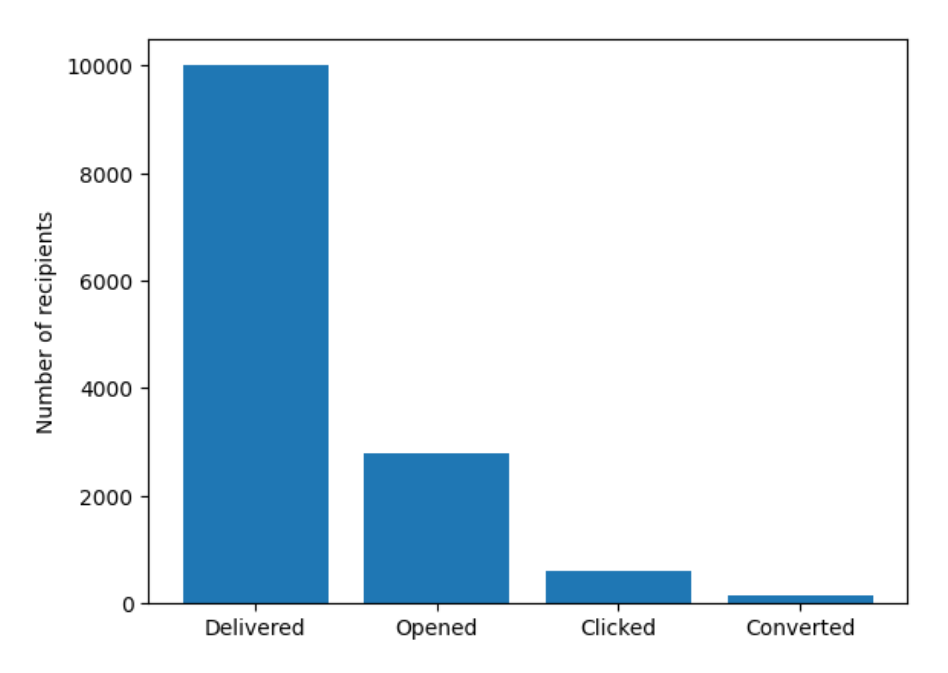
The following conversion chart illustrates the real-world behavior of email campaign recipients. It is clear that with each additional step, the number of users who complete the next step decreases, which underlines the importance of optimizing each individual phase of the campaign, from the email subject line to the landing page.
THE ROLE OF THE SUBJECT LINE AND PREHEADER
The email subject line and preheader represent the first and often only opportunity to grab the recipient’s attention in the “highly competitive” inbox environment. Their job is not to be creative at all costs, but to clearly and concisely communicate the value of opening the email. The subject line should set realistic, relevant expectations, while the preheader further develops and refines the message.
In the long run, the highest performance is achieved by subjects that are specific, understandable, and focused on the benefit to the recipient, not on the internal language of the organization or marketing phrases.
THE IMPORTANCE OF THE OPENING PART OF AN EMAIL
The first screen of an email, the content displayed without the need for further interaction from the user, is a key, decisive space. It must be immediately clear what the message is, why it is relevant, and what the recipient should do next. If this information is not communicated within the first few seconds, the likelihood of any further interaction drops dramatically.
Therefore, the opening part of the email must follow a clear hierarchy of messages, include a comprehensible headline, and a direct call to action that logically ties to the campaign’s main value proposition.
STRUCTURE AND READABILITY OF THE MESSAGE
The body of the email must develop the main message in a way that aligns with users’ actual reading behavior. Recipients do not read emails linearly like an article, but rather scan them for key information. For this reason, it is essential to work with a simple structure, short thematic blocks, and a clear visual hierarchy of content.
The text should gradually answer the questions: what the message is about, why the recipient should care, what specific benefit it will bring them, and what the next step should be. Everything else must be subordinated to this basic narrative.
THE CALL TO ACTION IS KEY TO CONVERSION
The call to action elevates the campaign’s communication level to the business level. It must be clearly formulated, specific, and aligned with the campaign’s main goal. Vague, general formulations reduce interaction rates because they do not explicitly convey a clear expectation for the next step.
In terms of email structure, the call to action should be visually dominant and naturally embedded in the message’s flow, serving as a logical conclusion to the argument. The appropriate placement of key elements is shown in the following image.

PERSONALIZATION IN EMAIL CAMPAIGNS
Dynamic personalization is one of the most important factors that separates average email campaigns from high-performing ones. It allows you to deliver messages to recipients based on their actual behavior, preferences, and customer relationship stage, rather than just general segmentation. This significantly increases the relevance of your communications, engagement rates, and likelihood of conversion.
The basis of controlled dynamic personalization is systematic work with data. This includes not only basic customer data but also information about their interactions, purchase history, reactions to previous campaigns, and web activity. The marketing platform connects this data and allows you to create dynamic target groups and content that adapts to a specific user in real time. Thanks to this, email becomes a relevant communication channel that brings higher business value.

MOBILE-FIRST AS THE DEFAULT DESIGN STANDARD
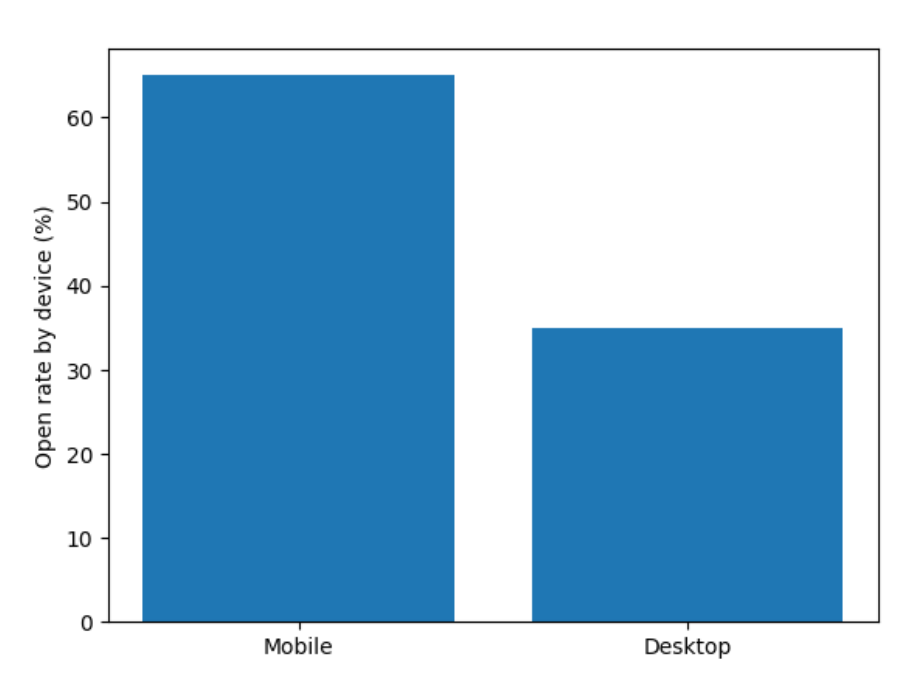
Given that most emails are read on mobile devices these days, campaign design must be mobile-first from the start. This should be reflected not only in the technical processing of templates, but also in the text length, paragraph structure, size of interactive elements, and overall complexity of the message.
The goal is to minimize the user’s cognitive load, enabling them to understand the message and perform the desired action with minimal effort.
The following chart shows a typical split between mobile and desktop.

PERFORMANCE MANAGEMENT THROUGH TESTING AND OPTIMIZATION
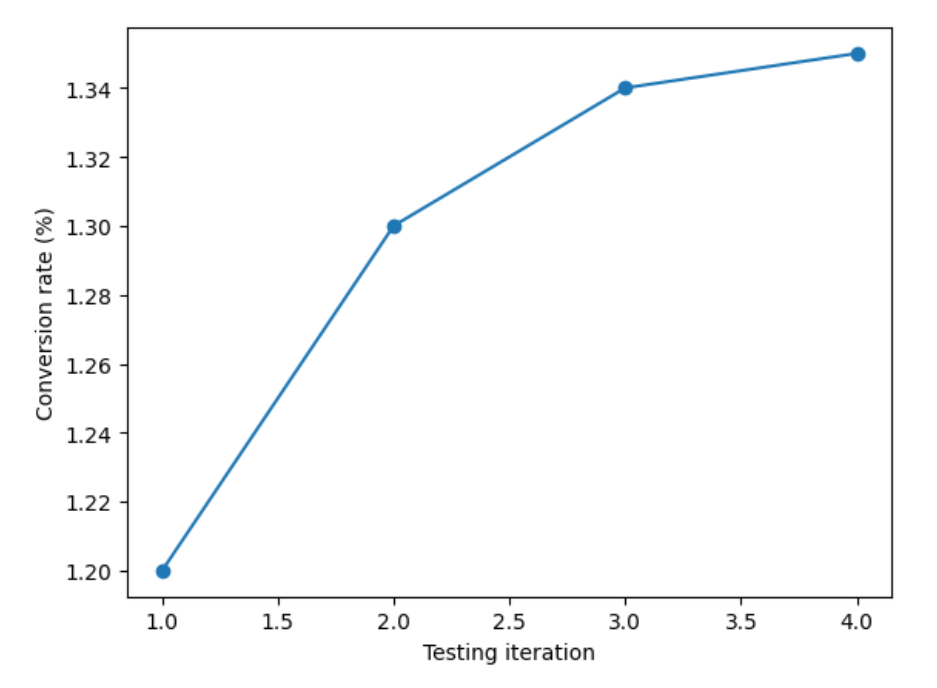
Effective email marketing cannot be managed in the long term based on intuition or subjective preferences. An essential part of a professional approach is systematic AB testing of key campaign elements and their continuous optimization based on real data. This applies in particular to email subjects, message structure, call-to-action wording, and the overall length and tone of communication. Only in this way can campaign performance grow in the long term while maintaining its relevance to the target audience.
The long-term performance of email campaigns results from systematic work with data and continuous optimization of key elements. The following chart illustrates a typical development of conversion rate over time when applying iterative testing and gradual campaign adjustments.
LANDING PAGE IN THE CONTEXT OF EMAIL CAMPAIGNS
The landing page is where the real success of an email campaign is decided. While the email is meant to get users to click, the landing page must translate that interest into concrete action. If the landing page doesn’t consistently follow up on the email message, trust and conversion potential are lost.
The key to an effective landing page is clarity. The user must immediately understand where they are, what is being offered, and what the next step is expected of them. The structure of the page should guide the visitor smoothly from the main message to the key benefits and to a single, clearly defined action.
Just like emails themselves, landing pages need to be designed with mobile in mind and continuously optimized based on data. Consistency, simplicity, and systematic testing are key factors that determine whether an email click actually converts into a business result.
TRUSTWORTHINESS, TRANSPARENCY, AND COMPLIANCE
An integral part of every email campaign must be the emphasis on the sender’s credibility and the transparency of communication. The recipient must always be clear about who the sender is and why the message is being delivered to them. The option to simply unsubscribe from further communication must also be mandatory.
These principles are not just a matter of legislative compliance but a key prerequisite for building long-term, sustainable relationships with customers.
MARKETING PLATFORM AND EMAIL CAMPAIGN MANAGEMENT
Innovative and powerful email marketing is essential to a marketing platform that connects customer data, template and content creation, automation, AB testing, and campaign performance evaluation. Without this technological foundation, it is impossible to target communication, work with customer behavior, or systematically increase campaign effectiveness.
The platform’s key functionality enables segmentation and automation, ensuring that individual recipients receive relevant messages at the right time. Equally important is the ability to measure campaign performance and test variations, which enables ongoing optimization and long-term growth in return on email investment.
CONCLUSION
A successful email campaign results from a strategic approach, disciplined message structure, and systematic, data-driven performance management. It is not a one-time creative activity, but a long-term managed process aimed at consistently generating measurable business results while strengthening the relationship between the brand and its audience.
RECOMMENDED
What is hot?
Marketing and psychology go hand in hand. To drive retention and boost…
Back-to-school campaigns only work when they target the right audience at the…
We’ve made top-tier marketing tools available for even the smallest e-commerce store.…
Orchestrating a seamless and exciting customer journey is the true test of…
We are excited to show you a brand new visual experience on…